
Friday, December 10, 2010
A Look Back at Second Semester at St. Mary's
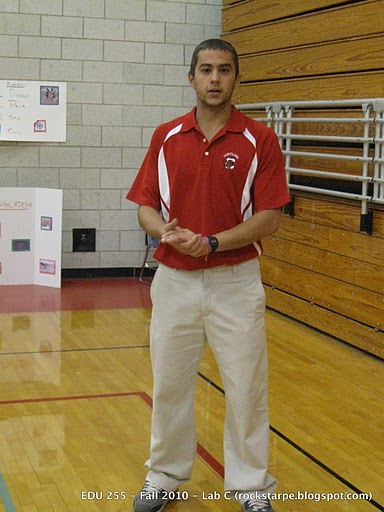
Coming back to St. Mary's this fall was one of my best decisions of the semester. The best part of the experience was the different lens that was on the 'camera' so to speak. Going to St. Mary's as a Lab Assistant rather than student I was able to look at the experience completely differently. Within my group was three rising Physical Educators, Jon, Daniel and Nicole. I was pleasantly surprised how much I enjoyed working with them. They looked at me for guidance and assistance, I never thought people would look to me for help like they did. Then it hit me; this is exactly what I want, to help students in the area of Physical Education. Now yes, Jon, Dan and Nicole were not necessarily my students but it is as close as I can get. The four of us kept good communication with each other, I gave them advice based on the previous knowledge I had from 201 in the Spring. I hope I made an impact on them and helped make an enjoyable experience. If I can find the time I would love to be an Assistant in 201 again or even 255. Below is a picture of myself during an intense, and I mean intense game of checkers, it ended in a tie, referee called it on account of time, but it was one for the ages. Working with children always reminds me how much I miss being young, well younger.


Homework 1, A Long Overdue Blog
What is meant by the idea that teaching is a goal-oriented activity?
For a goal-directed coordination of instructional activities and teaching methods, firstly we can define goals for education in terms of the ideas and skills we want students to learn. Next we must design activities and teaching methods that will provide opportunities for experience with these ideas and skills, and help students learn more from their experiences. Lastly, these goals must fall within the nation, state and local standards. Without any of this there is no sense of direction and fairly will surely ensue.
Why is the movement-task student response unit of analysis so important in physical education?
For a goal-directed coordination of instructional activities and teaching methods, firstly we can define goals for education in terms of the ideas and skills we want students to learn. Next we must design activities and teaching methods that will provide opportunities for experience with these ideas and skills, and help students learn more from their experiences. Lastly, these goals must fall within the nation, state and local standards. Without any of this there is no sense of direction and fairly will surely ensue.
Why is the process that teachers choose to use to teach content important?
The decision process instructors choose is so important because it helps them identify and meet their goals and objectives. There are a variety of processes you can choose from and there is a method for everyone. Instructors need to be prepared to teach their students in a variety of realms and it is vital that they have a process. Also, there are multiple processes teachers can choose from to teach content, if one way work well, that's good, but teachers can change it every now and then to keep students interested.
Why is the movement-task student response unit of analysis so important in physical education?
Movement-task student response unit of analysis is so important in physical education because it allows the teacher to asses the students, give feedback and it also allows the students to develop their motor skills. Physical Educators have to keep their students moving as much as they can, physical education is a vital part of every school and in order for it to thrive, movement-task student response should be optimal.
Sunday, December 5, 2010
Circuit Training: What a Workout!
This past monday, the 29th of November I continued my peer teaching in EDU 255 in Lab D. I was given Circuit Training to teach and at first I was a bit skeptical, anyone who knows me will almost never see me in the gym working out and if you took one look at me you'd probably agree.  In addition, the class had to incorporate a form of technology into our lesson. Technology is a key piece of every classroom and is vital for myself and my peers to be comfortable with it.

Technology like the heart rate monitors should be and are an integral part of every Physical Education class. Very easy to set up there should be no reason why it is not a part of the curriculum in Physical Education. After becoming familiar with it I feel very confident to do so again in the future. To the left you can see the heart rates of the class. The heart rates are linked to a program on a computer, each heart rate is assigned a number and therefore each student can see their own heart rate.

 In addition, the class had to incorporate a form of technology into our lesson. Technology is a key piece of every classroom and is vital for myself and my peers to be comfortable with it.
 When I sat down to write my lesson plan I was determined to make Circuit Training fun for everyone. Circuit Training is a form of high intensity aerobics and resistance training designed to be easy to follow and targets fat loss, muscle building and heart fitness. The best part of Circuit Training is how easy it is, anyone, anywhere can perform a full circuit with little to no equipment. However, Circuit Training is an intense workout that will have you sweating and gasping for breathe if performed properly. Therefore I really wanted to make this fun for everyone.
It was tough to make my lesson fun, especially considering my peers are not to thrilled to be working out so intensely and sweating when I am sure they would rather relax. After much contemplation, I decided to incorporate fun activities at each station that I hoped my peers would enjoy doing. For example, at one station I had my peers run on a 'treadmill', so to speak. A treadmill was not within my budget therefore I modified it a little bit. Rather than have my peers run on a treadmill, I had them do the 'Running Man.' Those not familiar with the Running Man, it is a dance move that was popular in the 1980s. Also, if my peers were not happy with the Running Man, I allowed them to perform a different dance, if they so wished.
For my lesson, I had seven stations set up in one half of the gym that included the treadmill, burpees, planks, jump ropes, step ups, dumbbells and sit-ups. I had modifications at each station if the workout was too intense for anyone. For example, if sit-ups were too strenuous my peers could have done crunches instead. After all of this, I felt that I made my lesson plan as fun as possible.
At the beginning of the lesson I had my peers record their resting heart rates in order to compare them to their heart rates after the workout. After brief viewing of the numbers recorded you can tell instantly once everyone starts working out. Viewing the chart, I can tell those who are working out intensely and those who are not. Heart rate monitors are a great way to see the intensity of my students, those who are and are not working hard. Some students were exhausted after the Circuit Training and their heart rates are so high that they needed to stop in order to get some rest. As seen below, Mark was out of breathe and needed to take a break, which just goes to show how intense the workout really is.

 To the left you can see the heart rates of the class. The heart rates are linked to a program on a computer, each heart rate is assigned a number and therefore each student can see their own heart rate.
 Going into my lesson I was very confident with my lesson, I had rehearsed what I was going to say and I think everything went well. I had activity progressions laid out and I was ready to go! Of course nothing ever goes according to plan, nonetheless, I feel like I did a good job. On paper however, when I developed the content, I got the impression I did not do a great job with the cues and tasks. Also, looking at my C-9 form almost all of the realms were covered, but not cues. I had a hard time with the cues because there we just so many! With seven stations the cues were countless. Looking back at it now I should have just had universal cues for each station and went along with that. It was a great learning experience though and I am glad I had this opportunity and look forward to the next time I can teach. In addition, I set up a 12 day block plan that can be very helpful in the future as a physical educator.
My feedback was really well, the best it has been. I was able to give feedback to more than 50% of the class and help them with the cues and tasks. As seen in this picture I was helping Jeremy and Greg with the 'treadmill' or Running Man.  I was very pleased with my feedback because prior to Lab D it has not been up to par. I made a point of it to give feedback and will do the same with all future teaching experiences. And I feel I used my time wisely as you can see in this Time Coding Form.
 I was very pleased with my feedback because prior to Lab D it has not been up to par. I made a point of it to give feedback and will do the same with all future teaching experiences. And I feel I used my time wisely as you can see in this Time Coding Form.
Dr. Yang always has tricks up his sleeves, and during my lab D I had to deal with some unruly students. Under orders from Dr. Yang, my classmates Ben, Laura, Nicole and Anthony were told to make it very hard for me to teach. In every classroom there is always one or more students who give the teacher a hard time and it is to be expected. Thus, I understand why Dr. Yang does so during Lab D and I'm grateful for the learning experience. When my classmates began to get out of hand I handled the situation pretty well but I certainly could have done a better job. I should have broken the trouble-makers up to eliminate the problem immediately to avoid it from the start. This picture will show the trouble they gave me, and I say trouble but it was pretty funny and I enjoyed the challenge.

As I mentioned previously, I was very nervous to teach Circuit Training, but all in all I think I passed with flying colors. I had a lot of fun and I hope my classmates did as well. Below are the videos of my teaching and links to all my documents.
Monday, November 8, 2010
Who knew teaching Kabaddi could be so much fun?
When Professor Yang instructed to the class that we will have to be teaching an international sport, admittedly so, I was nervous. Next, when my partner Greg and I decided to teach Kabaddi, the national sport of India and Bangladesh, yes I was very nervous. I was not sure if I would be able to learn a sport quickly, and well enough to teach it to a group of my peers. Nonetheless, I was up to the challenge and I did pretty well I think. It is very hard to squeeze so much information into such a short period of time but I did my best. I was able to include the native language of Bangladesh, that is Bengali, having the students counting from 1-10 in Bengali. Thus, I was able to get plenty of the culture into the lesson and it felt accomplishing to teach through the physical. I found it difficult to give feedback to my students, but I did the best I could, which truthfully was not all that spectacular. The skills I taught in Kabaddi were so simple that it was tough to give feedback because all of the students excelled in them. However, one can argue that I can simply give positive feedback to the students, so that is definitely an area I need to work on. Ultimately, I am really liking the way I am progessing as a teacher. Below are links to all of Kabaddi documents.
Monday, October 18, 2010
My Teaching, Ultimately Take 2

I was very happy with the outcome of Lab B2, I can see myself improving. This time around I had a great hook, signal for attention and safety statement. I had a great challenge to go along with my task that I instructed the class to do. I kept the instruction short and sweet and got the class moving as fast as I could. There is still one flaw that I know I need to work on, as I was walking around observing the students, I was not assessing the task that I had instructed them to work on. I gave comments on the fundamentals of basic frisbee throwing, rather than the pivoting, ducking and juking that I taught. Lastly, next time I teach I will be sure to demonstrate in game-like speed, most likely with a student in the class to give them a better idea of what I mean. I did not do that this time and the class seemed a little confused at what I was asking of them, thus I will be sure to fix my mistake next time.
Throughout the lesson, there was a microphone attached to my collar, recording everything being said and here is a transcription of just that. After transcribing it, I was happy with my performance, but there were a few things I still need work on. I lost count the amount of times I said 'Okay,' that has to be fixed and fast. Also, my assessing, can hardly be called assessing. Instead I just gave general feedback of basic fundamentals of Ultimate. In addition, there is a time coding form and a feedback analysis form I've filled out that breaks down the lesson completely so you can better understand how it went.
Monday, October 4, 2010
My Teaching, Ultimately

New Youth, Hitting Bingles

This past weekend my softball team, New Youth, was granted right to participate in a tournament of the best teams in the league. Having won our division in the regular season, we were put into a bracket of some of the best teams all across Long Island. We made it to the semi-finals but fell short in the last inning losing by only a couple of runs. However, we may have lost but it was some of the most fun I've had and I'm glad I went home for the weekend to participate. Playing softball with my team, my friends, is always a great way to spend your Sunday morning. After all the inside jokes, double plays, bingles (singles), home runs, put outs and much more it was a very successful season. Pictured below is a picture of the team after the championship game of the regular season, above is a picture of me from the 2009 season, in a tournament New Youth entered in and won.

Subscribe to:
Posts (Atom)